
Arctic Cruise Tourism: Navigating Nature, Commerce and Culture in Northern Communities (ACT)
NNA Track 1: Collaborative Research: Navigating Impacts of the Arctic Tourism Industry on Nature, Commerce, and Culture in Northern Communities (ACT) is an international, interdisciplinary research project funded by the US National Science Foundation (Award 2022529).
The project is a collaboration between George Washington University, PI: Robert Orttung, Co-PIs Sheryl Elliott and Seleni Matus; University of Alaska Southeast, PI Jim Powell; University of Colorado, Boulder, PI Astrid Ogilvie, Co-PI Martin Miles.
The overarching goals of the ACT project are to: i) systematically document, compare and interpret the ways in which cruise ships in Arctic and adjacent waters are impacting coastal communities; and ii) work together with local decision makers to develop a set of community-defined data-driven indicators to determine policies for the enhancement of local adaptive capacities to identify, monitor, forecast and respond to effects from cruise ships. The project ended 2026.
The project was presented in a session at the Arctic Circle Assembly Conference in Reykjavík, Iceland, at 8am on Saturday 10 October entitled: Arctic Cruise Ship Tourism Revisited. See https://www.arcticcircle.org/assemblies/2026-arctic-circle-assembly
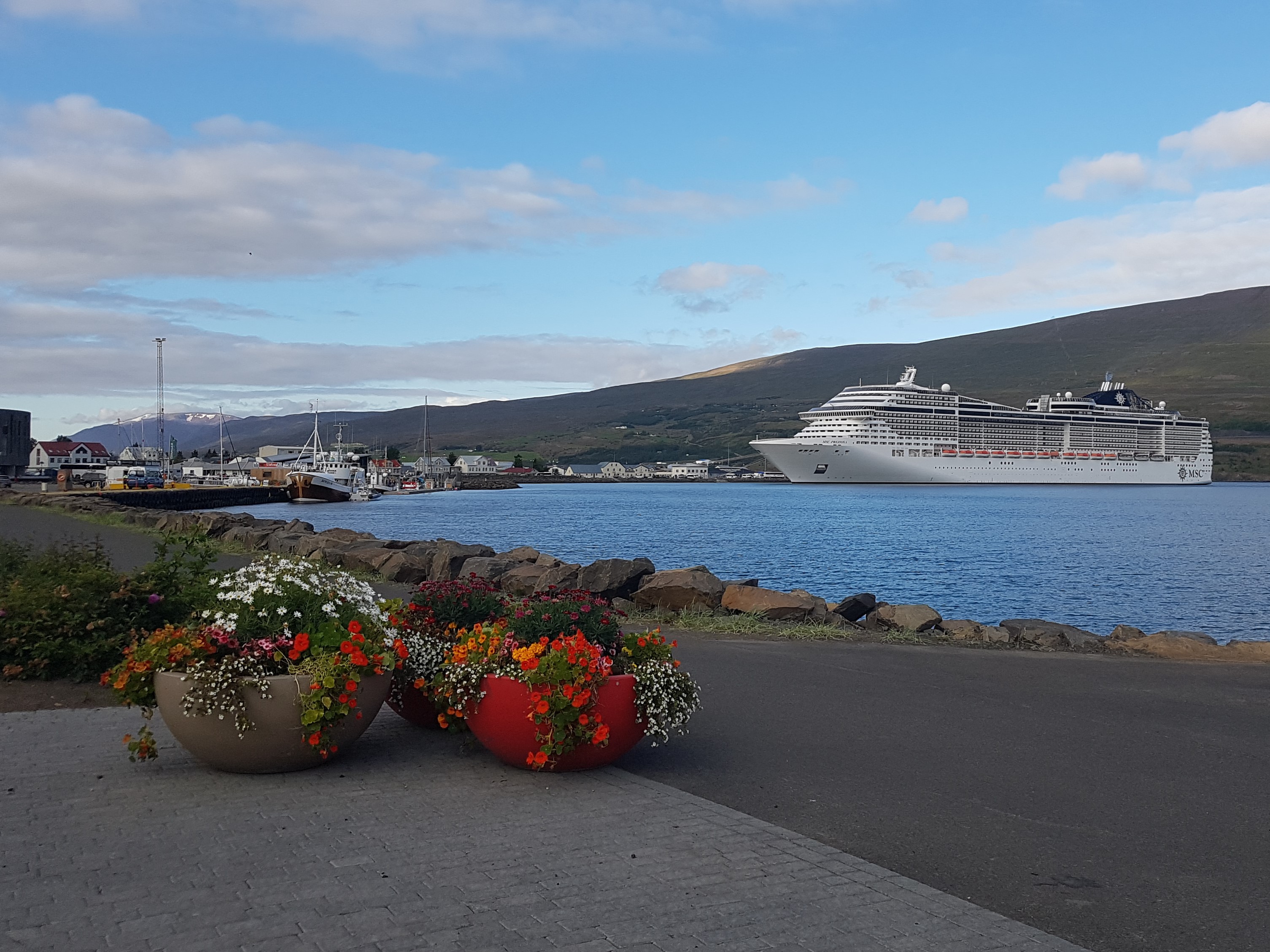
Cruise ship tourism in northern regions has grown substantially during the past fifty years. This growth has been a double-edged phenomenon for the affected communities, bringing new monetary benefits to otherwise limited economic futures but also undesirable environmental impacts such as air emissions (including greenhouse gases), wastewater discharge, and noise. The project investigated five locations. Two in Alaska in the United States: (Nome, population 3,639; and Juneau, population 31,600) and three northern European locations: (Bergen, Norway, population 294,000; Akureyri, Iceland, population 22,870; and Visby, Sweden, population 26,300). Nome has the least cruise tourism (1,800 visitors annually) while Juneau has the most at 1.6 million passengers in 2024. Until 2018, Visby welcomed only small ship tourism and ferries. In 2024, new docks accommodated 160,500 cruise ship tourists. Akureyri, Iceland's northern capital, is much smaller than the other European locations. Cruise-ship visitors in Akureyri reached 321,966 in 2024 and consequently port officials are working toward a policy to limit the number of visitors and favour small ships over large ship tourism. Project research suggests that European destinations have stronger collaborative local authority and governmental arrangements with regard to tourism planning, and higher legitimacy relative to United States of America (US) case studies, which rely more on conflictual approaches (Powell, et al., 2026b).
For further information see also: https://www.arcus.org/nna/projects/2022699
For information and highlights on "Interviews on Impacts of the Arctic Cruise Tourism Industry on Nature, Commerce, and Culture in Northern Communities (2021–2025)" see the links below.
- Martin Miles, Robert Orttung, James Powell, & Astrid Ogilvie. (2026). Interviews on Impacts of the Arctic Cruise Tourism Industry on Nature, Commerce, and Culture in Northern Communities (2021–2025). Arctic Data Center. doi:10.18739/A2DR2PB5D. See also https://arcticdata.io/all/news/2026/10/cruise-tourism/.
PROJECT OUTPUTS INCLUDE THESE PUBLICATIONS
- Powell, J. E., Orttung, R. W., Anton Clavé, S., & Matus, S. (2026a). Governance agency in a contested cruise destination: a legitimacy-evolutionary approach. Tourism Geographies, 28(3), 617–650. https://doi.org/10.1080/14616688.2026.2661058
- Powell, J. E., Orttung, R. W., White, E., Juni, R., Miles, M. W., & Ogilvie, A. E. J. (2026b). Polycentric governance of cruise environmental impacts. Annals of Tourism Research Empirical Insights, 7(2), Article 100235. https://doi.org/10.1016/j.annale.2026.100235
The Icelandic Tourism Research Centre (ITRC) has been an active partner in ACT Supervision on behalf of ITRC: Guðrún Þóra Gunnarsdóttir (gudrunthora@rmf.is), Þórný Barðadóttir (thorny@rmf.is) and Ása Marta Sveinsdóttir (asamarta@rmf.is)


 Norðurslóð 4 (7th floor)
 600 Akureyri, Iceland